Captivity
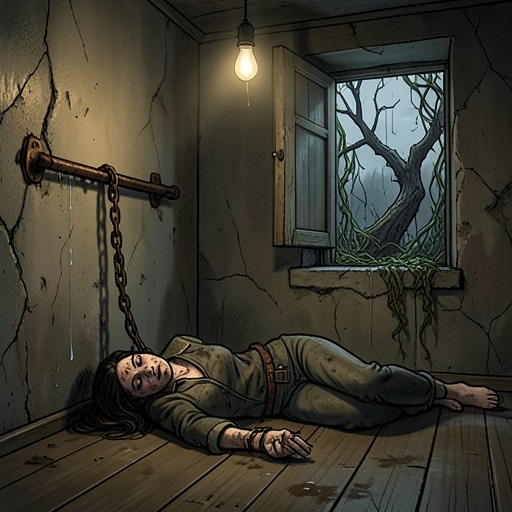
The ThicketCaptivity in the novel is not limited to imprisonment behind bars. It includes abduction, forced dependence, racialized confinement, and the seizure of people from the relationships and places that give them identity. The condition drives Jack Parker’s pursuit of Lula Parker, structures the danger faced by Spot, and reaches backward into the remembered history of slavery and forward into the lawless spaces of the Big Thicket.
Definition and First Crisis
Captivity becomes central after the Sabine River ferry disaster. The wreck scatters people, animals, and bodies, and the survivors’ accounts are uncertain: three men, a girl, and some horses reached the opposite bank, with a fat man and a large man riding one horse and a Black man and a girl riding another. The girl did not appear willing to accompany them. This uncertainty turns the disaster into more than a catastrophe of water. It creates a crisis of identification in which survival and abduction are difficult to separate.
Jack Parker supplies the decisive personal meaning of the scene. He knows that his sister, Lula Parker, and his grandfather were among those connected to the crossing; his grandfather had been shot and was already dead before the water devil struck. The men then took Lula. Jack’s immediate objective is therefore not simply to survive the wreck but to recover a sister removed from him by force. The rough river makes direct pursuit impossible, while the advice to seek the law emphasizes how captivity converts private grief into a problem of jurisdiction and protection.
The episode also establishes captivity as a condition imposed through movement. Lula is not described as being held in a conventional cell; she is carried away across a river by armed men while Jack is injured, disoriented, and unable to follow. The separation is geographical, familial, and emotional at once. Her possible resistance is visible only through the witness’s impression that she was unhappy to go, showing how little voice a captive may possess within the accounts of others.
Historical Continuity
The novel links modern captivity to the older violence of slavery. Eustace Cox explains that his mother was Black and Comanche and that a Cox man, roughly forty-five years earlier, had fathered him against her will. His account makes kinship itself bear the mark of coercion: the Cox family had once owned his mother’s people, and his mixed ancestry is the result of power exercised through racial domination and sexual violence. Eustace reverses Jack’s uneasy assumption about racial difference by insisting that it is he who is “part of” Jack, because the Cox and Parker families had intermarried. Captivity therefore survives not only in missing persons but in inherited family structures.
A Black worker later describes another form of post-slavery captivity through labor and property. He had cultivated excellent farmland for Old Man Rutledge, but after Rutledge died, the widow resented having to pay him in crops and wages for work that her family had once extracted from his people for free. The economic transition from ownership to paid labor has not erased the old hierarchy; it has merely changed its legal form. His land knowledge and agricultural skill give him bargaining power, but his employment remains vulnerable to white resentment over the loss of unpaid labor.
Eustace’s personal freedom is likewise constrained by the conditions surrounding him. Shorty explains that Eustace can track exceptionally well but becomes overconfident, drinks when bored or too certain of himself, and cannot handle alcohol. For that reason Shorty keeps Eustace’s shotgun, limits the money available to him, and receives some of his earnings for safekeeping. Eustace is not legally imprisoned, but addiction, racial hostility, and the danger of his own reactions narrow his freedom. Shorty’s protective control is simultaneously care and restriction: it prevents Eustace from selling the gun for liquor or shooting people who insult him, while acknowledging that his skin color exposes him to abundant occasions for anger.
Captivity in the Borderlands
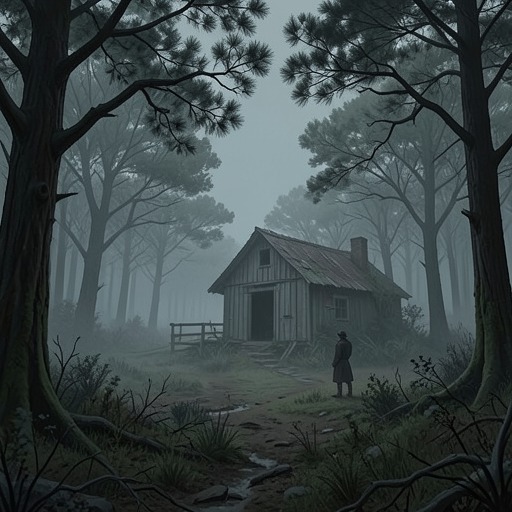
The Big Thicket intensifies the condition because it is both refuge and danger. After Fatty Worth’s interrogation, the pursuers learn that the remaining gang members and Lula are heading into the Thicket beyond Livingston, among dense woods, high pines, outlaws, and Black people who have fled there to trap and live. The place is difficult for the law to enter and return from safely. Its remoteness allows people to escape official control, but it also gives armed criminals room to hide captives beyond ordinary protection.
The Thicket is presented as a historically occupied landscape rather than empty wilderness. Its roads are marked by sawmills, workers, and the expanding machinery of extraction. At one sawmill, Black laborers cut limbs from logs by hand while a gasoline-driven saw reduces the surrounding forest to industrial noise. Such details place captivity beside labor and development: bodies are controlled in the cabin, on the farm, and at the sawmill, while the land itself is reorganized for profit. The forest offers concealment, but the logging road shows that commercial power is already cutting through it.
The remembered history of Sheriff Winton’s ranch makes captivity part of the region’s wider cycle of dispossession. Shorty recalls that Comanche people seized Winton’s wife and young daughter during a raid after settlers had moved onto land they regarded as their own. The girl was taken when she slipped outside to see a new calf; her mother followed after hearing her scream, and both were carried away while Winton and Shorty struggled to prepare a pursuit. Winton’s later mutilation and rescue do not erase the fact that the violence arises within a contested colonial frontier, where settlers, Comanche communities, buffalo hunters, bounty hunters, and armed authorities occupy the same space under incompatible claims.
Spot and the Captive Body
Spot’s captivity is the story’s most direct depiction of deliberate bodily domination. At the gang’s cabin, Cut Throat Bill and Nigger Pete strip Spot, restrain him near the fire, and torture his chest with burning wood. Cut Throat sits on Spot’s legs while Nigger Pete holds his arms and pins the back of his head against a knee. Cut Throat also spits tobacco on him while speaking words that cannot be understood. The method is designed not merely to injure but to reduce Spot’s agency, leaving him unable to answer violence with movement or speech.
The scene places Spot’s suffering beside a chained black bear. The bear has a thick logging rope tied around one hind leg and is bound to a tree with roughly twenty feet of movement. Men throw dirt clods at it, laugh when it rises and growls, and later fire at it as it runs in confusion. The parallel is unmistakable without making the two captives identical: both are held by force, displayed to indifferent observers, and treated as objects for the captors’ amusement. The bear’s rope and Spot’s restrained limbs make captivity visible as a technology of control.
Spot sees, or may see, Jack through a split in the brush. His face briefly softens as though rescue has arrived, but he does not call out. The uncertainty is crucial. Jack cannot know whether Spot recognized him, whether silence protects Jack from discovery, or whether Spot is too exhausted to make a sound. In any case, Jack is unable to help. Captivity here defeats solidarity at the moment it is most urgently desired: a witness is present, but the captive remains physically and strategically unreachable.
Rescue, Recapture, and Release
The assault on the cabin reverses the power arrangement but does not produce an easy rescue. The bear breaks free and distracts the gang, allowing Jack, Eustace Cox, and Shorty to close in. Lula emerges from the cabin wearing the same clothes as before, but they are ragged; she appears thin, haggard, and older. Her altered appearance records captivity as a condition that changes the body even when the captive survives.
Lula does not recognize Jack when she first sees him. She notices only that he is carrying a gun and retreats into the cabin, with Fatty Worth rushing inside after her. Her reaction shows how captivity damages recognition and trust. Jack’s presence should signify family and safety, yet the weapon makes him resemble the armed men who have controlled her. The immediate result is another separation inside the very scene intended to end her captivity.
Cut Throat Bill then grabs Lula by the arm and drags her through the open back door. Jack cannot shoot because he fears hitting her, and Shorty does not have a clear shot. The captive becomes a shield, and rescue again creates a tactical dilemma in which Lula’s physical safety limits the rescuers’ use of force. Jack’s pursuit is briefly stalled not by lack of determination but by the captor’s ability to turn Lula’s body into protection for himself.
The broader outcome is nevertheless a movement from forced possession toward restored agency. The gang’s hold is broken during the shootout, and Lula ultimately returns to Jack’s household. Later, she is able to leave with Shorty by choice, marry him in Hinge Gate, and hold his hand wherever they go. That later relationship does not cancel the violence she endured, but it sharply contrasts chosen attachment with abduction. Captivity had removed her from family and decision; the ending gives her a future in which movement and intimacy are voluntary.
Wider Significance
Captivity organizes the novel’s moral geography. Rivers, roads, farms, cells, cabins, and forests are all spaces where people may be carried, confined, exchanged, exploited, or recovered. The story places Lula’s abduction beside slavery’s family separations, racialized labor, Eustace’s constrained independence, Winton’s family tragedy, and Spot’s torture to show that freedom is never merely the absence of a locked door. It depends on whether a person can retain bodily safety, family connection, economic control, and the ability to choose where to go.
The ending does not pretend that the world has become fair. The gang’s violence leaves deaths, injuries, and psychological damage, while the history of slavery remains embedded in family memory and social relations. Yet the later rebuilding of homes and farmland, the decision to preserve the trees rather than exploit every possible oil reserve, and the marriages formed through consent provide a limited counterimage to seizure and ownership. Captivity is therefore both a plot condition and a historical pattern: the force that tears people from one another, and the pressure against which the characters define protection, kinship, and freedom.